
Introduction: A Trust-Driven Industry in a Click-First World
The finance industry has always operated on two non-negotiable pillars: trust and precision. Banks, insurance firms, investment platforms, and fintech startups handle people’s money, data, and long-term security. Yet in today’s digital-first economy, even the most traditional financial institutions must compete in a landscape dominated by search engines, social platforms, automation, and data analytics.
This is where digital marketing and the finance sector intersect in powerful—and sometimes controversial—ways.
From personalized loan offers powered by AI to compliance-driven content strategies, marketing within finance is no longer about flashy ads alone. It is about credibility, education, transparency, and measurable outcomes. Institutions that understand this shift are gaining market share, while those that resist are slowly losing relevance.
In this in-depth guide, we explore how modern marketing techniques are transforming financial services, the opportunities they unlock, the risks they introduce, and what the future holds for this high-stakes industry.
https://shubdigital.site/blog/
1. The Evolution of Marketing in Financial Services
From Branches to Browsers
A decade ago, customer acquisition in finance relied heavily on physical branches, relationship managers, and offline advertising. Today, most customer journeys begin online—often with a Google search or a social media scroll.
Consumers now expect:
- Instant access to financial information
- Seamless digital onboarding
- Transparent comparisons between products
- Educational content before committing funds
As a result, financial brands have shifted from product-centric promotion to customer-centric digital engagement.
Rise of Fintech and Competitive Pressure
Fintech startups accelerated this transformation by:
- Leveraging performance marketing
- Using mobile-first experiences
- Simplifying complex financial concepts
- Building trust through content and UX
Traditional institutions were forced to adapt, leading to widespread adoption of digital channels across banking, insurance, wealth management, and lending.
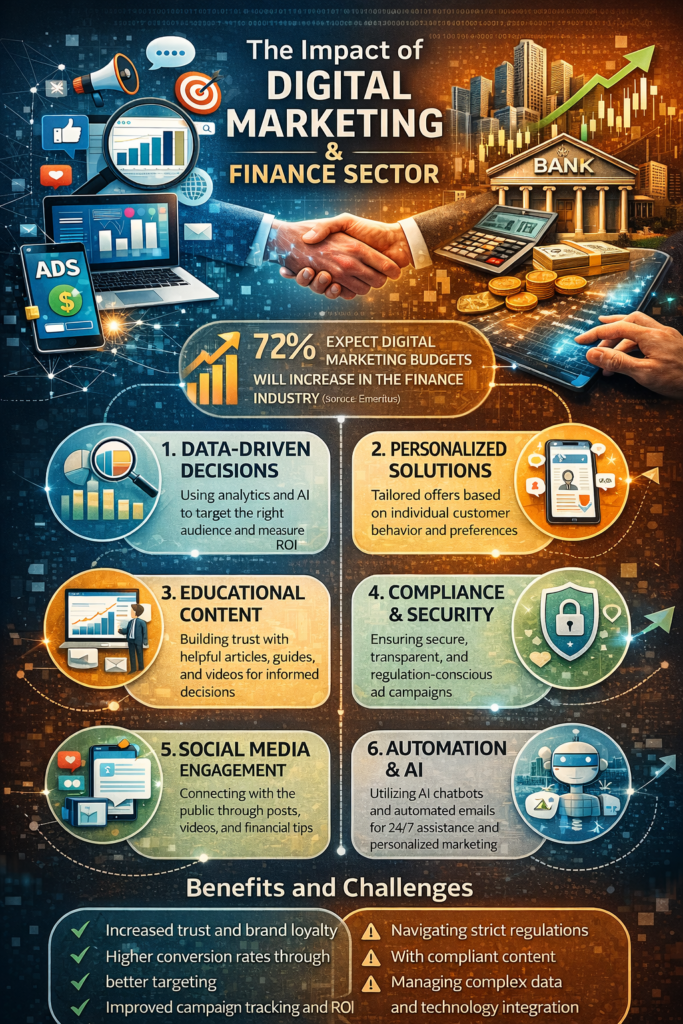
2. Why Digital Marketing Matters More Than Ever in Finance
Trust Is Earned Before the Sale
In finance, users rarely convert on impulse. Whether it’s opening a savings account or investing in mutual funds, decisions are deliberate and research-driven.
Digital marketing enables financial brands to:
- Educate before selling
- Address fears and objections early
- Demonstrate authority through content
- Build long-term credibility
High-quality blogs, videos, webinars, and explainer pages often influence decisions weeks or months before a conversion occurs.
Data-Driven Precision
One of the biggest advantages of modern marketing in financial services is measurability. Institutions can track:
- Cost per lead
- Lifetime customer value
- Funnel drop-offs
- Channel-wise ROI
This level of insight allows smarter budget allocation and better personalization—critical in a margin-sensitive industry.
3. Key Digital Marketing Channels Transforming Finance
Search Engine Optimization (SEO)
SEO plays a foundational role because financial queries are often intent-driven:
- “Best credit card for cashback”
- “Home loan interest rates”
- “How to invest safely”
Ranking organically for such queries:
- Builds trust
- Reduces long-term acquisition costs
- Attracts high-quality leads
However, SEO in finance demands accuracy, compliance, and user-first content due to strict regulatory scrutiny.
Content Marketing and Financial Education
Content is not optional in finance—it is essential.
Effective content strategies include:
- Investment guides
- Tax planning blogs
- Insurance explainers
- Market insights and reports
Educational content positions brands as advisors rather than sellers, which is especially powerful in a sector where trust dictates choice.
Paid Advertising and Performance Marketing
Paid channels like Google Ads and social media campaigns allow:
- Quick visibility for competitive keywords
- Retargeting high-intent users
- Promotion of specific financial products
That said, advertising in finance comes with challenges:
- High cost per click
- Ad platform restrictions
- Strict disclosure requirements
Success depends on precision targeting, compliant messaging, and continuous optimization.
Social Media and Community Building
Once considered unsuitable for finance, social platforms now play a major role in:
- Brand awareness
- Financial literacy
- Customer engagement
LinkedIn dominates B2B finance, while Instagram, YouTube, and X (Twitter) are increasingly used for:
- Short-form education
- Market commentary
- Personal finance tips
Humanized communication helps financial brands appear approachable without compromising professionalism.
4. The Role of Personalization and AI
Smarter Experiences Through Data
Personalization has become a game-changer in how financial products are marketed. With user consent and ethical data usage, institutions can:
- Recommend relevant products
- Customize email communication
- Predict customer needs
For example, a first-time salary account holder requires very different messaging than a high-net-worth investor.
AI in Marketing Automation
AI-driven tools now support:
- Predictive analytics
- Chatbots for customer queries
- Dynamic content delivery
- Fraud detection in campaigns
When used responsibly, automation enhances efficiency without eroding trust.
5. Compliance, Privacy, and Ethical Challenges
Marketing Under Regulation
Few industries face as much regulatory oversight as finance. Marketing teams must comply with:
- Advertising standards
- Data protection laws
- Financial disclosures
- Platform-specific policies
One misleading claim can damage brand reputation and invite legal consequences.
Data Privacy and Consumer Trust
As personalization increases, so do privacy concerns. Consumers are more aware of how their data is used and expect transparency.
Responsible marketing in finance requires:
- Clear consent mechanisms
- Ethical data usage
- Honest communication
- Secure digital infrastructure
Trust lost is difficult—and expensive—to regain.
6. Measuring ROI in Financial Marketing
Beyond Vanity Metrics
Clicks and impressions alone mean little in finance. Real success is measured by:
- Qualified leads
- Conversion quality
- Customer lifetime value
- Retention and cross-selling
A holistic attribution model helps identify which channels truly drive profitable growth.
Long-Term Value Over Short-Term Wins
Unlike retail, financial relationships often span years. A single customer may generate value through:
- Multiple products
- Renewals
- Referrals
Effective digital strategies focus on sustainable growth rather than quick wins.
7. The Future of Digital Marketing in Finance
Voice Search and Conversational Finance
As voice assistants become mainstream, financial queries are becoming more conversational. Optimizing content for natural language will be crucial.
Video and Interactive Content
Explainer videos, calculators, and interactive tools simplify complex financial concepts and boost engagement.
Stronger Focus on Financial Literacy
Brands that invest in education rather than aggressive selling will stand out. Financial empowerment builds loyalty and long-term brand equity.
Conclusion: A Strategic Necessity, Not an Option
The relationship between digital marketing and the finance sector is no longer experimental—it is fundamental to survival and growth.
Financial institutions that embrace transparency, education, data intelligence, and ethical practices are building resilient brands in an increasingly competitive environment. Those that ignore digital evolution risk losing relevance to more agile, customer-centric players.
The future belongs to financial marketers who can balance innovation with responsibility, technology with trust, and growth with governance.
In finance, marketing success isn’t about being louder—it’s about being clearer, smarter, and more trustworthy.
https://www.walkersands.com/about/blog/digital-marketing-for-financial-services/
